




This article guides the selection of photoelectric sensors types for conveyor systems in automated production lines, covering applications from high-speed packaging to heavy assembly. It reviews 7 sensor types, detailing their working principles and suitable scenarios. Key factors like detection distance and environmental adaptability are analyzed to ensure high accuracy, eliminate false triggering, reduce downtime, and achieve stable, cost-effective operation.
Select the appropriate photoelectric sensor for the conveyor belt system to ensure the stable operation of the entire automated production line. Whether your application scenario is a high-speed packaging production line, drug visual inspection system, or as heavy vehicle parts assembly conveyor belt. The type of sensor, detection distance and environmental adaptability directly determine the detection accuracy, equipment operation rate and overall use cost.
This article will sort out the working principles and applicable scenarios of 7 mainstream conveyor belt photoelectric sensors to help you accurately match technical solutions, completely eliminate false triggering, reduce downtime, and achieve high-speed and stable detection.
What Is A Photoelectric Sensor?
The photoelectric sensor is a photoelectric detection device that uses the emission and reception changes of the beam to detect the presence, location, or distance of a moving object on the conveyor belt.
In simple terms, it emits a beam of light. When the object blocks, reflects or changes this beam of light, the receiver of the sensor will capture this change and send the electrical signal to the PLC.
Comparison of 7 Photoelectric Sensors Types
The following covers the 7 most mainstream photoelectric sensor technologies in the field of industrial automation, from detection distance, core advantages to typical applications:
| Compare 7 mainstream photoelectric sensors | ||||
|---|---|---|---|---|
| Sensor Type | Detection Range | Feature | Environment | Typical Application |
| Through Beam | Up to 30 m | Anti-interference, high precision, unaffected by color or material | Dusty / Outdoor | High-speed packaging line counting, material positioning, warehouse roller shutter doors |
| Retrore-flective | Up to 10m | Single-sided wiring, High reliability | Indoor / Outdoor | Packaging and bottling production line, logistics sorting, automated warehousing |
| Diffuse Reflective | 0mm-7m | Integrated design, suitable for use in confined spaces | Clean / Low dust | Simple Existence Detection, Label / chip detection |
| BGS (Background suppression) | 30-300mm | Unaffected by color and backgroundq | Mixed surfaces | Hybrid production line/ shiny object sensing |
| Color Mark Sensor | 8-25mm | Color / contrast detection | Controlled lighting | Registration mark tracking |
| Fiber Optic | 0-1m | Confined space, high precision, high flexibility | Indoor/High-precision environment | Semiconductor / food lines |
| Laser | Up to 30m | Beam focusing/beam spot visible | Clean / Precision | Label / chip detection, dimension check |
Details of Different Photoelectric Sensors Types
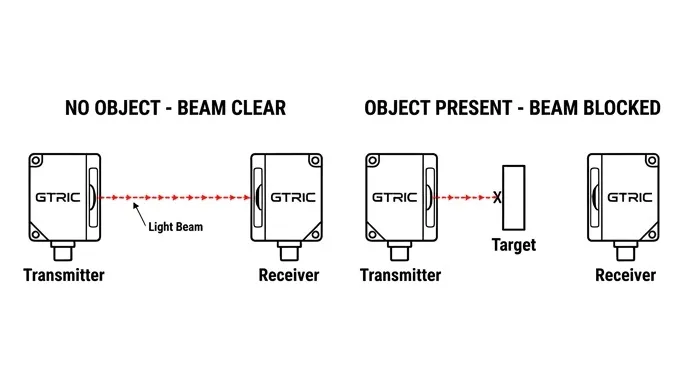
1. Through Beam Photoelectric Sensors–long distance conveyor belt detection
The through beam photoelectric sensor places the transmitter and receiver on both sides of the detection area, and triggers the output when the target object blocks the beam.
Since the receiver only responds to the modulation frequency of the paired transmitter, its ability to resist ambient light interference is strong. It is suitable for occasions requiring long-distance induction and strong resistance to environmental interference.
- Detection distance: 0.1m to 30m
- Typical applications: pallet detection, large carton counting, AGV channel perception, etc.
- Note: Both the transmitting and receiving ends need to be wired, and the installation cost is high.
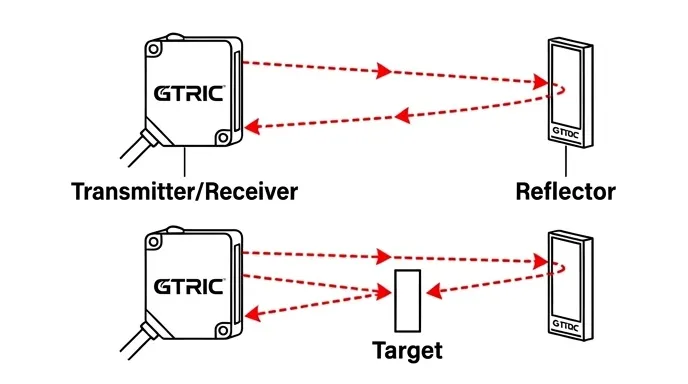
2. Retroreflective Photoelectric Sensors–unilateral wiring, easy operation
The transmitter and receiver are set in the same shell, and the light beam is reflected back by the corner prism, which is triggered when the target interrupts the optical path. Compared with the opposite type, only one-sided wiring is required, which greatly reduces the installation complexity.
- Detection distance: up to 10m
- Typical applications: packaging line bottle body, carton transmission, elevator door protection, etc.
- Note: When testing transparent glass or transparent PET material, it is recommended to use polarized light type.
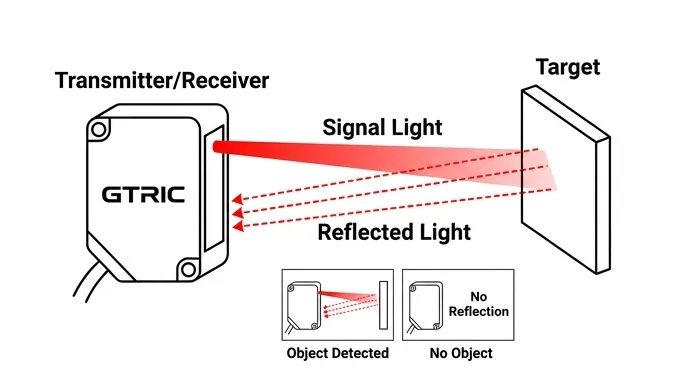
3. Minimal Requirements for Diffuse Reflective Photoelectric Sensors
Directly using the diffuse reflection light of the target surface for detection, without installing a reflector or a receiver on the opposite side, is the fastest solution when the opposite side of the conveyor belt cannot be wired.
- Detection distance: 0mm to 10m
- Typical applications: positioning confirmation before robot picking, label detection, pipeline counting of small parts, etc.
- Note: Due to the target surface color and reflectivity changes vary, the selection needs to consider the amount of margin.
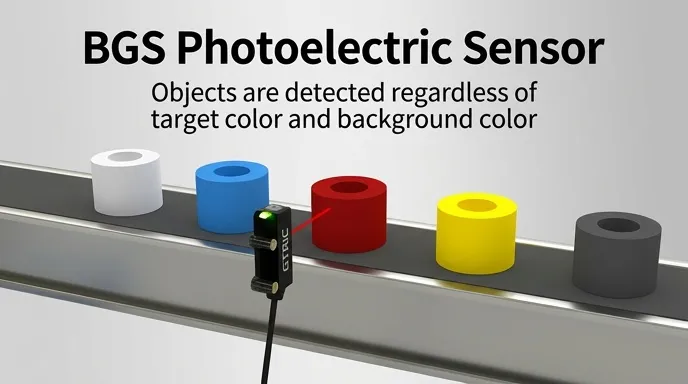
4. Background Suppression Sensors–eliminating background interference
Using the principle of triangle ranging, the target within a fixed distance is targeted during operation, while the background outside the target is ignored. On surfaces of various colors or reflective conveyor belts, the BGS sensor can avoid false contact. The detection distance is virtually unaffected by object color (very small difference between black and white), surface gloss, or background. It also features high repeatability and low false alarm rates, perfectly solving the two major pain points of color sensitivity and background interference in mixed automated production lines.
- Sensing distance: 30 mm to 300 mm (most cases)
- Typical applications: PCB board in place confirmation, bright metal parts perception, multi-layer goods highly layered detection, etc.
More information can be found in—BGS Photoelectric Sensor: 5 Powerful Applications in Industrial Automation.
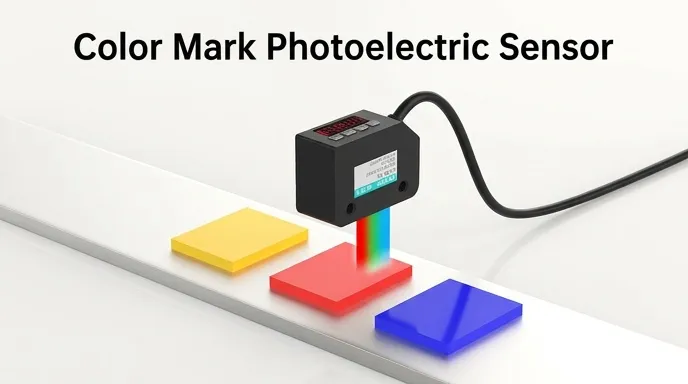
5. Color Mark Photoelectric Sensors–High Speed Printing & Packaging Positioning
By using a built-in RGB three-color light source, the sensor emits light of a specific color (which can be switched between red, green, blue, or white) onto the surface of the object being measured to detect color differences. The response time can be as low as 50 µs, making it suitable for high-speed packaging, printing, registration, and positioning.
- Sensing distance: 8 mm-25 mm
- Typical applications: packaging positioning, printing line synchronization control, label edge detection, etc.
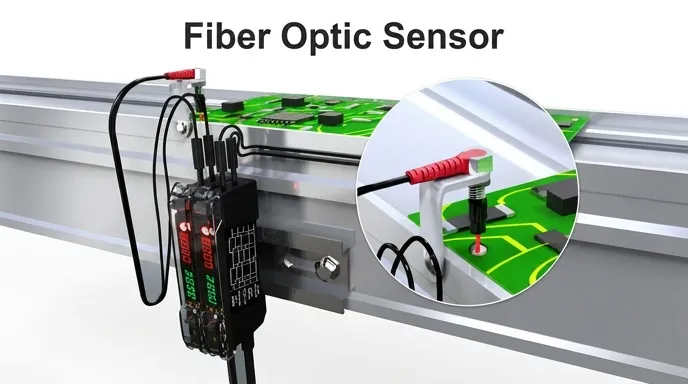
6. Optical Fiber Photoelectric Sensors–anti-interference condition
The amplifier body is designed to be separate from the sensing probe, allowing the optical signal to be emitted by the amplifier and transmitted through flexible optical fiber, enabling detection in confined or harsh environments. The sensing end has no electronic components and can operate stably in corrosion-resistant and strong electromagnetic interference situations from -20 °C to +55 °C.
- Detection distance: 0-25m
- Typical applications: food and beverage cleaning line, semiconductor detection, etc.
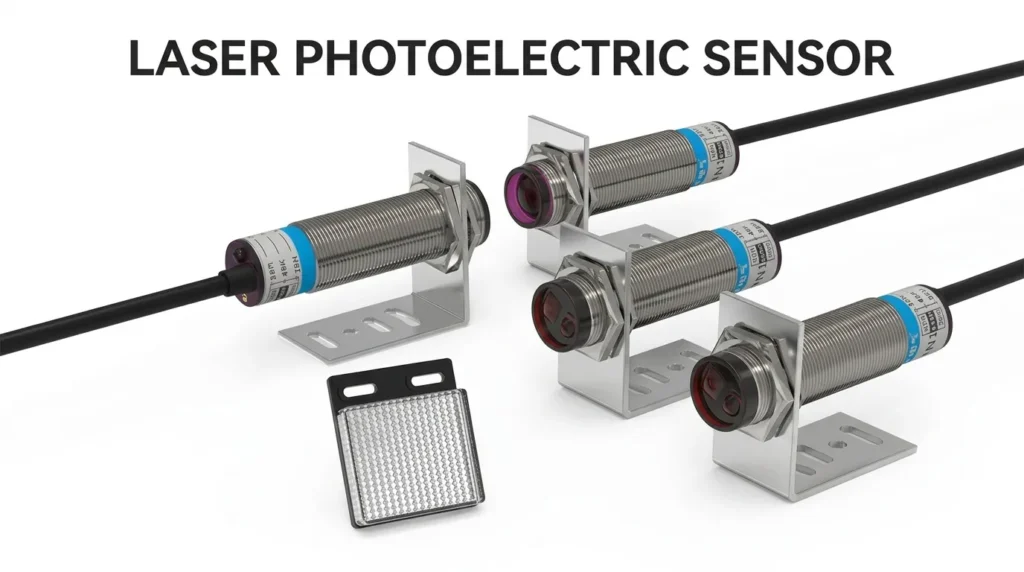
7. Laser Photoelectric Sensors–ultra precision, long distance
The detection principle of this laser photoelectric sensor is exactly the same as that of a regular photoelectric switch. It uses a laser instead of a red/infrared LED, making the beam invisible but the spot visible. The spot diameter can be less than 0.5 mm, and it still maintains extremely high repeatability and positioning accuracy over long distances. It is the ultimate solution for size measurement, precision alignment, and high-speed counting.
- Detection distance: 0.1 mm to 100 m (opposite laser type)
- Typical applications: automatic sorting system, size on-line detection, high-speed counting, etc.
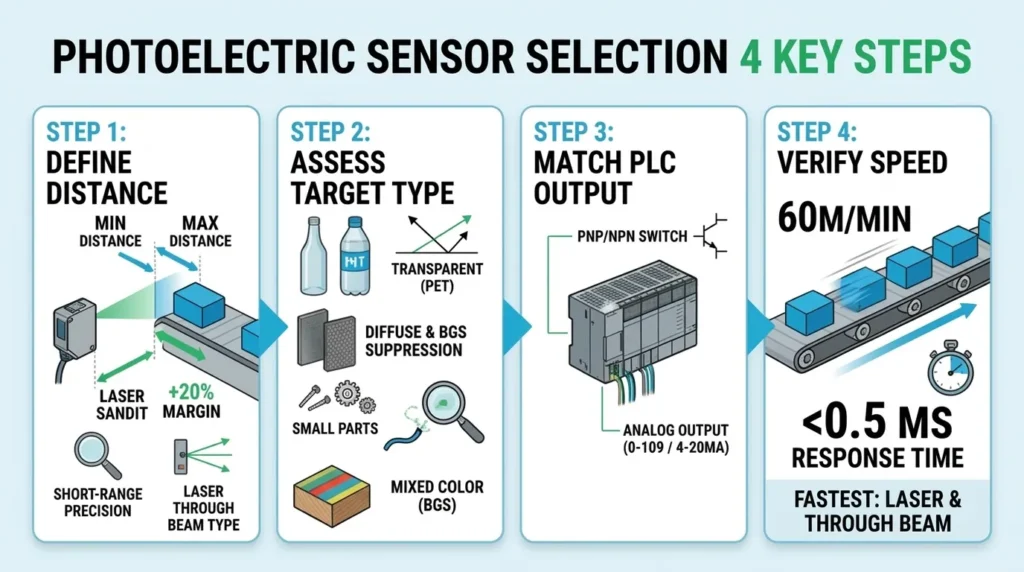
Photoelectric Sensor Selection 4 Steps
Step 1, Clarify the detection distance.
Measure the nearest and farthest distance from the sensor installation point to the target, and set aside 20% safety margin. The short-range precision detection (5m) is preferred to the opposite type or laser type.
Step 2, Analyze the characteristics of the target object
- Transparent glass / PET material: select polarized light reflection plate or opposite laser type
- Dark matte surface: with BGS or through-beam type
- Small parts (<3 mm): choose fiber optic or laser point sensor
- Mixed color surface: BGS background suppression
Step 3, Match the PLC output signal type
Confirm the output type required by the controller: NPN or PNP switch output, analog output (0-10V / 4-20mA), or IO-Link interface that supports remote parameter adjustment and intelligent diagnosis.
Step 4, Consider the transmission speed and response time
When the transmission speed is 60m/min and the target length is 50 mm, the sensor with response time < 0.5 ms is required. Laser type and through beam type usually have the fastest switching speed.
Gtric photoelectric sensor
Gtric is a professional brand focusing on the field of industrial sensors. It provides a complete photoelectric sensor product line covering all the above 7 types and is widely used in the fields of automatic transmission, detection, positioning and security.
The Gtric sensor is designed with IP67 / IP69K full-sealed protection and CE / RoHS compliant circuit architecture to meet the harsh working conditions of many industries such as automobiles, food, electronics, and logistics. Each product is provided with a complete technical data manual to support application compliance certification.
For product selection support, technical specification comparison or batch quotation, please contact Gtric Technology directly to obtain professional selection suggestions for your specific application conditions.
Gtric related recommended articles
What is the difference between the photoelectric sensors and proximity sensors?
The proximity sensor (inductive / capacitive) needs the target to enter its sensing area to trigger. Its detection distance is usually 1-60 mm, and the inductive can only detect the metal target. The photoelectric sensor performs non-contact detection through a beam of light, and the detection distance can reach 10m. It is effective for almost all materials such as metal, plastic, glass, and paper, and has a wider range of applications.
Can photoelectric sensors detect transparent objects?
Of course, it can. But you need to choose the special model. Ordinary diffuse reflection and standard reflection plate sensors can’t reliably detect transparent glass bottles or transparent PET materials, because the light beam penetrates the target and cannot be reflected. Polarized Retroreflective photoelectric sensors should be selected, or a detection for transparent objects using through beam laser sensors should be adopted.
How to choose the IP lever of photoelectric sensors in the industrial field?
IP67 (dustproof and short-term immersion) is selected for general indoor clean occasions; iP69K (80°C / 80bar high pressure water jet) must be selected for food and beverage, slaughter and other occasions that need high pressure hot water cleaning. It is recommended to use the opposite installation method with protective cover for outdoor or heavy dust occasions.